Ao se falar sobre arte no Brasil, somos remetidos à intenção modernista de criar uma arte de caráter nacional, e nesse sentido pergunto: a necessidade de afirmar a autonomia da pintura (como se configurava em outros países e foi um dos assuntos chave da teoria greenberguiana) não estaria sendo substituída por uma euforia de brasilidade que abordou essa questão calcada na literalidade e no regionalismo? A arte modernista brasileira seguiu os mesmos princípios internacionais, teve êxito em seu objetivo ou se configurou como uma adaptação de linguagens importadas aos critérios de aceitação nacionais?
O problema é atual na medida em que os artistas podem estar continuando a se espelhar em realidades alheias ao seu contexto, o que implica na criação de uma arte descompromissada não só com um caráter nacional (ainda que não acredite que essa deva ser a finalidade de uma obra de arte), mas descompromissada com ela mesma, se pensarmos arte como manifestação da expressão individual e coletiva em um determinado espaço-tempo.
Nos trabalhos de Tarsila do Amaral, por exemplo, a ênfase na referência ao caráter nacionalista da arte pode ser encontrada no emprego de cores “caipiras” (Abaporu), no apelo social e político (Trabalhadores), sendo estas características que estão longe de configurar uma totalidade.
Do ponto de vista de sua temática (cultura regional, desigualdades sociais, a tecnologia nos centros urbanos) ao tratá-la a partir de fatores regionais acredito que se passa longe de idenificar uma identidade nacional como intentava a mais ousada proposta modernista no país. Aspectos que poderiam ser abordados de um ponto de vista mais abrangente seriam aqueles aos quais todos, ou a grande maioria da população tem acesso.
Do ponto de vista da linguagem o Brasil é um país composto por culturas diversas e miscigenações cujas influências se fazem sentir com maior impacto em regiões geograficamente mais específicas. Não se poderia afirmar que um índio ou um mineiro representam a cultura nacional, ou qualquer outro arquétipo da população isoladamente, do mesmo modo como não se pode afirmar que um cocar ou as cores de artesanato em diferentes tonalidades apasteladas, sob uma visualidade "simplista" de influência européia, configuram a identidade de um povo.
Estes aspectos, na minha opinião, fazem pensar que a aclamada obra de Tarsila deixa a desejar, se não vai além do esboço de uma linguagem infantilizada em cuja superficialidade se escancaram intenções que impossibilitam trancender pequenos focos da realidade brasileira na primeira metade do século XX.
Wednesday, July 27, 2005


Thursday, July 14, 2005

Thursday, July 07, 2005
Relatórios sobre perdas
Zoe Leonard
1961 NY, EUA; onde vive e trabalha até hoje
Zoe Leonard vê a sua abordagem da fotografia como uma espécie de observação, a qual compara também à atividade da caça e da recolha: o seu ponto de partida é sempre algo dado, um objeto ou situação, com que depara nas viagens, embora a atenção que dedique a cada objeto resulte do interesse pessoal que considere que tem para si. Com isso, o seu trabalho adquiriu uma constante, nomeadamente uma preocupação com a percepção visual: “Trata-se do poder da visão e do poder de uma verdade subjetiva” A câmara toma o lugar do olhar, substitui-me”. Ainda que Leonard afirme que não faz parte de qualquer tradição fotográfica, e que procede muito de forma instintiva, podem, no entanto, encontrar-se referências históricas no seu trabalho. Na série de vistas aéreas, criada em meados da década de 80, que procura localizar vestígios da civilização, ela parece ir buscar inspiração à série de Ed Ruscha, Parking Lots, de 1967. Noutros trabalhos, como os manequins de montra, as vitrinas e os modelos anatômicos, ela volta aos métodos usados na fotografia surrealista. A sua obra distingue-se menos por um uso sensível da luz e da composição que pelos temas perturbadores e fragmentários, e por um sentido dos materiais que não procura ocultar a qualidade efêmera e utilitária do meio. Muitas da imagens de Leonard mostram vestígios de uso: “A razão por que deixo o pó nas minhas obras em exposição e não corrijo as perfurações e falhas é porque quero que o observador perceba que uma fotografia é uma obra sobre papel. É um objeto. Não é a realidade. Não é verdadeiro.” Da mesma forma, ao nível pictórico, ela concebe estratégias para abalar o caráter ilusório da imagem fotográfica e a pretensão a um ponto de vista neutro e superior invisível: em alguns trabalhos, vêem-se as estruturas através das quais tirou as fotografias, como a janela de um avião que se introduziu no campo de visão enquanto fotografava uma formação de nuvens. Na década de 1990, Leonard deixava normalmente uma guarnição preta em torno de suas fotografias quando fazia as impressões, a fim de enfatizar o seu caráter material.
Na década de 1980, Leonard trabalhou não apenas na área artística, mas também no domínio do ativismo político, o que exige outras formas de produção e outras leituras. No entanto, mesmo quando Zoe Leonard explora o trabalho artístico por sua própria conta, independentemente das premissas, este não pode ser separado dos seus projetos de ativista. Como membro do Act Up (Aids Coalition to Unleash Power), do grupo feminista WAC (Women’s Action Coalition), e dos coletivos de mulheres artistas Gang and Fierce Pussy, de que foi membro fundador, Leonard luta, entre outras coisas, contra as políticas restritivas da AIDS nos EUA. As suas ações, que são levadas a cabo com os meios empregados pela publicidade, são dirigidas contra o sexismo e a estigmação de soropositivos, exigindo igualdade social e cuidados médicos adequados.
1961 NY, EUA; onde vive e trabalha até hoje
Zoe Leonard vê a sua abordagem da fotografia como uma espécie de observação, a qual compara também à atividade da caça e da recolha: o seu ponto de partida é sempre algo dado, um objeto ou situação, com que depara nas viagens, embora a atenção que dedique a cada objeto resulte do interesse pessoal que considere que tem para si. Com isso, o seu trabalho adquiriu uma constante, nomeadamente uma preocupação com a percepção visual: “Trata-se do poder da visão e do poder de uma verdade subjetiva” A câmara toma o lugar do olhar, substitui-me”. Ainda que Leonard afirme que não faz parte de qualquer tradição fotográfica, e que procede muito de forma instintiva, podem, no entanto, encontrar-se referências históricas no seu trabalho. Na série de vistas aéreas, criada em meados da década de 80, que procura localizar vestígios da civilização, ela parece ir buscar inspiração à série de Ed Ruscha, Parking Lots, de 1967. Noutros trabalhos, como os manequins de montra, as vitrinas e os modelos anatômicos, ela volta aos métodos usados na fotografia surrealista. A sua obra distingue-se menos por um uso sensível da luz e da composição que pelos temas perturbadores e fragmentários, e por um sentido dos materiais que não procura ocultar a qualidade efêmera e utilitária do meio. Muitas da imagens de Leonard mostram vestígios de uso: “A razão por que deixo o pó nas minhas obras em exposição e não corrijo as perfurações e falhas é porque quero que o observador perceba que uma fotografia é uma obra sobre papel. É um objeto. Não é a realidade. Não é verdadeiro.” Da mesma forma, ao nível pictórico, ela concebe estratégias para abalar o caráter ilusório da imagem fotográfica e a pretensão a um ponto de vista neutro e superior invisível: em alguns trabalhos, vêem-se as estruturas através das quais tirou as fotografias, como a janela de um avião que se introduziu no campo de visão enquanto fotografava uma formação de nuvens. Na década de 1990, Leonard deixava normalmente uma guarnição preta em torno de suas fotografias quando fazia as impressões, a fim de enfatizar o seu caráter material.
Na década de 1980, Leonard trabalhou não apenas na área artística, mas também no domínio do ativismo político, o que exige outras formas de produção e outras leituras. No entanto, mesmo quando Zoe Leonard explora o trabalho artístico por sua própria conta, independentemente das premissas, este não pode ser separado dos seus projetos de ativista. Como membro do Act Up (Aids Coalition to Unleash Power), do grupo feminista WAC (Women’s Action Coalition), e dos coletivos de mulheres artistas Gang and Fierce Pussy, de que foi membro fundador, Leonard luta, entre outras coisas, contra as políticas restritivas da AIDS nos EUA. As suas ações, que são levadas a cabo com os meios empregados pela publicidade, são dirigidas contra o sexismo e a estigmação de soropositivos, exigindo igualdade social e cuidados médicos adequados.
Em 1992, Leonard instalou um dos seus primeiros trabalhos com base num site da documenta 9, introduzindo-lhe um elemento do seu trabalho como ativista. Entre os retratos históricos de mulheres que já existiam nas salas do museu, introduziu fotografias de vaginas ao estilo dos cartazes do Gang, numa alusão também so quadro L’Origine du Monde, de Gustave Courbet, 1866. Leonard queria chamar a atenção para o fato de “as mulheres serem demasiado representadas como objetos, mas pouco representadas como produtoras. Nisso, o nosso sexo está demasiado representado como algo para que se vê, mas pouco representado como algo que experienciamos”.

De 1992 a 1997, dirigiu sua atenção para uma obra serena e frágil intitulada Strange Fruit (Estranho Fruto), derivada com seu confronto com a morte de um amigo, David Wojnarowicz. Espalhou cascas de fruta cheias de algodão, ou acrescentou-lhes um fecho-éclair para poderem ser fechadas e criarem o aspecto de frutos inteiros. As cascas vazias atuavam como objetos de transição no seu processo de luto e recordação; o ato de reparação e junção dos pedaços estava dirigido para a reconstrução da memória da pessoa perdida, a criação simbólica de um passado “cicatrizado”. As fotografias que ela tirou nesse âmbito – artigos de roupa suja, uma cicatriz no corpo da mãe ou um dente postiço que usou quando era criança, “são (...) a procura de beleza em locais onde fomos feridos pela violência ou a negligência”.
 Strange Fruit (for David) (detail), 1992-’97; by Zoe Leonard; fruit peel (orange), thread, needle, variable dimensions. Photo by Vivien Bittencourt from a 1995 installation at Paula Cooper Gallery, New York.
Uma sociedade que não suporta desvios


Em Preserved Head, ela mostrou a cabeça cortada e preservada de uma mulher com barba que ela descobriu num arquivo obscuro do Musée Orfila, em Paris. É um objeto sem nome ou identidade, que foi obrigado a servir de exemplar científico de “formas biológicas desviantes”: “Do meu ponto de vista, esta série não é tanto sobre a mulher com barba, mas sobre nós como sociedade que não suporta desvios. (...) Como é que o seu corpo pode ter ido parar nas mãos de gente que a decapitou?”

Preserved Head of a Bearded Woman, Musée Orfilia, 1991
Serie mit 5 Fotografien, Gelatin-Silber-Papier, s/w
90 x 62 cm, 60 x 41 cm, 78 x 53 cm, 91 x 62 cm, 67 x 47 cm
courtesy: Paula Cooper Gallery, New York

Para a série “The Faye Richards Photo Archive” (Arquivo Fotográfico de Faye Richards), 1993-1996, Leonard encenou a fotobiografia de uma lésbica negra lendária que viveu em inícios do século XX. Além do seu trabalho como criada, Faye Richards é atriz de cinema, uma mulher que na vida real teria ficado na obscuridade, uma vez que não há registro oficial da história de uma tal “Black Hollywood”.
Fonte: "Mulheres Artistas nos séculos XX e XXI", Editado por Uta Grosenick, Ed. Taschen.
Tuesday, June 28, 2005
Army Of The Dolls - Gisela Capitain, Cologne, Germany, Anthony Meier, San Francisco
Art in America, Feb, 2001 by Judith E. Stein
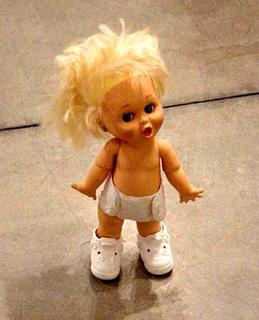
Zoe Leonard's recent installations and photographs, examining the time-worn objects that people leave behind, manage to evoke both nostalgia and resolve.
In her youth, the Victorian heroine of Peter Carey's 1988 novel Oscar and Lucinda appalls her frugal family by mutilating an expensive birthday doll. Despairing of her own frizzy mane, the nine-year-old Lucinda treats her toy as a surrogate self. She yanks out its curly blonde locks and artlessly affixes horsehair snippets that more closely resemble her parents' straight black tresses.
When in 1999 artist Zoe Leonard came upon such real-life playthings in tag sales and flea markets, she was struck by the physical evidence of wear and alterations which together were tantamount to autobiographies. These girlhood souvenirs pointed toward a psychosexual terrain worth surveying. Leonard ultimately amassed nearly 700 dolls in "played-with condition"--as the secondhand dealers described them--for use as raw material in her art. As an unintended by-product of these transactions, she accumulated a quantity of cast-off suitcases used to carry home her purchases.
It was after she remembered the dignified terra-cotta warriors of Xian, China, entombed for millennia in a stop-action march, that she understood how to utilize her growing stockpile of toys. For Mouth open, teeth showing, the principal installation in her recent show at Paula Cooper Galley in New York, Leonard stood 162 dolls at stately intervals, approximately 3 1/2 feet apart in a loose grid. Visitors entering Cooper's airy truss-roofed gallery could wade into a shallow sea of miniature women and girls, along with life-sized newborns, all as individual as the children who once owned them. The dolls with movable limbs has been coaxed into a walking stride, arms gently swinging. The generous distance between the rows allowed viewers to explore. A calm "personal space" encircled each winsome belle and eerily silent infant in the spooky Toyland army.
The phrase "mouth open, teeth showing," is doll collectors' parlance for valued feature of the early models made with smiling faces. Leonard liked the physicality of the words, which implied both passivity and aggression, encompassing the mixture of vulnerability and menace presented by a vast roomful of pint-sized people. Leonard initially titled the work Citizen and thought of it as a sociological reflection of female participation in the world. She found that her 75 Barbies were not suitable for inclusion because they literally couldn't stand on their own two feet. As she lived with her collection in her studio, the layered implications of working with human surrogates opened up to her.
Like Bernd and Hilla Becher's photographic series of closely related structures, Leonard's ranks of dolls invited the eye to discover the differences among them. No two were identical. Even when produced by the same manufacturer, each was subjected to unique alternations. The criteria for comparison expanded as one looked. A few were brandnew; others were bitten, broken or soiled. They were attired, undressed or partially clad. Several wore endearingly personalized getups, such as a tatted cape and matching tam-o'-shanter. Hair was another arena for individuation: their unruly coiffures frequently revealed the intervention of scissors, paint or girl-sized barrettes. Each figure was a richly contradictory repository of inaccessible memories along with socially decodable content.
The assembly spanned nearly a century, the earliest an antique composition doll ca. 1910 (the term refers to a wood pulp material that is cast in molds and then painted), the latest one still available in shops. Leonard offered such formal polarities as garish and subdued or big and little, and hinted at subtle narratives. A circumspect older girl in pajamas held her position next to a jubilant black cherub decked out as an in-line skater. A perky infant, head cocked as if listening, adjoined an armless, sooty-faced child with downcast eyes. Leonard's telling placements hinted at the diverse experiences of girlhood, with its potential for both joy and abuse. One ludicrous doll decked out in a purple flowered dress arrested attention. Holding her ground on chunky, Stakhanovite legs, she defiantly displayed a bald pate rising above a multitude of platinum plaits.
Leonard's grounded congregation staked a claim of kinship with Carl Andre's floor-based grids.(1) Viewers might also perceive consanguinity with Mike Kelley's floor installations of grimy stuffed animals and handmade toys. Closer to the present, Leonard's stripped and partially dressed dollies recall the live, wigged mannequins who constitute Vanessa Beecroft's sculptural modules. Indeed, Mouth open, teeth showing bears a stronger resemblance to Beecroft's staged performances of ambiguously vacuous young women than it does to the work of either Laurie Simmons or Ellen Phelan, for example, who have employed dolls in photographs and paintings. But unlike Beecroft's idlers, Leonard's marchers bespeak the artist's feminist intentions by suggesting group solidarity and a capacity for action.
Leonard created a second, untitled sculpture opposite the gallery's reception desk by stacking 77 suitcases against the wall in seven irregular piles. Like the participants in a police lineup, these frontal towers of slightly differing heights impassively awaited the scrutiny of visitors passing through the transitional space of the foyer. Arranged more for shape and color than by graduated size, the columns occasionally mimicked figurative curves. The palette leaned toward cool, tasteful hues, with sky blue predominating. Here again, the artist selected a range of vintage examples. Some, bearing brand names such as Amelia Earhart, Travel Joy and Shy Flite, were artifacts from an era when you dressed up to travel.
All found objects, particularly luggage, give off a lost quality. Many of the cases were personalized with monograms and scuffed by wear. Like the dolls once conveyed inside them, they no longer belonged to the people who had used them. Although visually ungendered, the suitcases were, as are all containers, readable as female biological metaphors. Variations in shape, surfaces and fastenings offered clues about their histories. Some handles--for example the sleek, molded-plastic ones of the '60s--are linked to specific moments in the history of design. Several cases conjured up cinematic images: the smart little tote stolen from runaway Claudette Colbert in It Happened One Night (1934) or the substantial baggage encumbering a married George Segal trysting with Glenda Jackson in A Touch of Class (1973). Darker allusions to the assembled property of Holocaust victims came to mind as well.
Leonard's thematic subtext of lost and found carried through into the final section of the exhibition, a selection of 10 new dye-transfer photographs hung in the front gallery. This series of found still lifes, or "organized remains," in the artist's description,(2) was harvested from sites and shop windows on New York's Lower East Side. Like Leonard's earlier black-and-white works, they form part of a larger, ongoing project that she regards as an urban archive of the handmade world. Part social anthropologist and part material culture expert, Leonard consistently gravitates toward the literal and symbolic signs of life that people leave behind.
With deadpan humor, she shot Sunshine Hotel in a flophouse, its name proclaimed by besmeared ceramic tiles mounted on a scarred red wall. Hand-lettered signage predominates in the photographs of glass-fronted stores: a pinked-edged yellow oval brashly asserts the availability of cold beer; a butcher perplexingly proclaims equal stocks of "goats, lamb, veal, breast"; adjacent to its graffiti-adorned siding, a seedy laundromat mournfully informs passersby of its hours and services. The two hand-me-down chairs loitering outside this enterprise might be the homeless relatives of the pompous upholstered pair smugly waiting inside a showroom in another print from this series.
A sense of quietude emanates from these artfully simple unpeopled views. Some show us figural stand-ins--for example, two orderly pairs of used shoes on makeshift mats, or a tailor's dignified dummy wearing a half-constructed jacket. Leonard's compositional strategy of "getting rid of surrounding noise" eliminates all that might compete with her visual target. In all of the work in this show, we are left with an intensely focused image that speaks in a soft, clear voice about what it is like to be human.
(1.) Leonard's previous installation Strange Fruit (1995) was also floor-based. It comprised strewn orange, apple and banana skins that had been laboriously reassembled and stitched. Like Antaeus, the Giant son of Mother Earth in Greek myth, all of Leonard's floor installations derive a special strength from a literal connection to the ground.
(2.) All quotes are from a telephone conversation with the author, Nov. 9, 2000.
Zoe Leonard's installations were on view at Paula Cooper Gallery, New York [Oct.21-Nov. 25, 2000]. New works will be shown at Gisela Capitain, Cologne [March], Anthony Meier, San Francisco [April], and Raffaella Cortese, Milan [September]. In addition, Mouth open, teeth showing will be on view at Wesleyan University, Middletown, Conn., in August and September.
Judith Stein, an independent curator and critic, is writing a biography of the late art dealer Richard Bellamy.
COPYRIGHT 2001 Brant Publications, Inc.
COPYRIGHT 2001 Gale Group
fonte: Find Articles.com

Zoe Leonard's recent installations and photographs, examining the time-worn objects that people leave behind, manage to evoke both nostalgia and resolve.
In her youth, the Victorian heroine of Peter Carey's 1988 novel Oscar and Lucinda appalls her frugal family by mutilating an expensive birthday doll. Despairing of her own frizzy mane, the nine-year-old Lucinda treats her toy as a surrogate self. She yanks out its curly blonde locks and artlessly affixes horsehair snippets that more closely resemble her parents' straight black tresses.
When in 1999 artist Zoe Leonard came upon such real-life playthings in tag sales and flea markets, she was struck by the physical evidence of wear and alterations which together were tantamount to autobiographies. These girlhood souvenirs pointed toward a psychosexual terrain worth surveying. Leonard ultimately amassed nearly 700 dolls in "played-with condition"--as the secondhand dealers described them--for use as raw material in her art. As an unintended by-product of these transactions, she accumulated a quantity of cast-off suitcases used to carry home her purchases.
It was after she remembered the dignified terra-cotta warriors of Xian, China, entombed for millennia in a stop-action march, that she understood how to utilize her growing stockpile of toys. For Mouth open, teeth showing, the principal installation in her recent show at Paula Cooper Galley in New York, Leonard stood 162 dolls at stately intervals, approximately 3 1/2 feet apart in a loose grid. Visitors entering Cooper's airy truss-roofed gallery could wade into a shallow sea of miniature women and girls, along with life-sized newborns, all as individual as the children who once owned them. The dolls with movable limbs has been coaxed into a walking stride, arms gently swinging. The generous distance between the rows allowed viewers to explore. A calm "personal space" encircled each winsome belle and eerily silent infant in the spooky Toyland army.
The phrase "mouth open, teeth showing," is doll collectors' parlance for valued feature of the early models made with smiling faces. Leonard liked the physicality of the words, which implied both passivity and aggression, encompassing the mixture of vulnerability and menace presented by a vast roomful of pint-sized people. Leonard initially titled the work Citizen and thought of it as a sociological reflection of female participation in the world. She found that her 75 Barbies were not suitable for inclusion because they literally couldn't stand on their own two feet. As she lived with her collection in her studio, the layered implications of working with human surrogates opened up to her.
Like Bernd and Hilla Becher's photographic series of closely related structures, Leonard's ranks of dolls invited the eye to discover the differences among them. No two were identical. Even when produced by the same manufacturer, each was subjected to unique alternations. The criteria for comparison expanded as one looked. A few were brandnew; others were bitten, broken or soiled. They were attired, undressed or partially clad. Several wore endearingly personalized getups, such as a tatted cape and matching tam-o'-shanter. Hair was another arena for individuation: their unruly coiffures frequently revealed the intervention of scissors, paint or girl-sized barrettes. Each figure was a richly contradictory repository of inaccessible memories along with socially decodable content.
The assembly spanned nearly a century, the earliest an antique composition doll ca. 1910 (the term refers to a wood pulp material that is cast in molds and then painted), the latest one still available in shops. Leonard offered such formal polarities as garish and subdued or big and little, and hinted at subtle narratives. A circumspect older girl in pajamas held her position next to a jubilant black cherub decked out as an in-line skater. A perky infant, head cocked as if listening, adjoined an armless, sooty-faced child with downcast eyes. Leonard's telling placements hinted at the diverse experiences of girlhood, with its potential for both joy and abuse. One ludicrous doll decked out in a purple flowered dress arrested attention. Holding her ground on chunky, Stakhanovite legs, she defiantly displayed a bald pate rising above a multitude of platinum plaits.
Leonard's grounded congregation staked a claim of kinship with Carl Andre's floor-based grids.(1) Viewers might also perceive consanguinity with Mike Kelley's floor installations of grimy stuffed animals and handmade toys. Closer to the present, Leonard's stripped and partially dressed dollies recall the live, wigged mannequins who constitute Vanessa Beecroft's sculptural modules. Indeed, Mouth open, teeth showing bears a stronger resemblance to Beecroft's staged performances of ambiguously vacuous young women than it does to the work of either Laurie Simmons or Ellen Phelan, for example, who have employed dolls in photographs and paintings. But unlike Beecroft's idlers, Leonard's marchers bespeak the artist's feminist intentions by suggesting group solidarity and a capacity for action.
Leonard created a second, untitled sculpture opposite the gallery's reception desk by stacking 77 suitcases against the wall in seven irregular piles. Like the participants in a police lineup, these frontal towers of slightly differing heights impassively awaited the scrutiny of visitors passing through the transitional space of the foyer. Arranged more for shape and color than by graduated size, the columns occasionally mimicked figurative curves. The palette leaned toward cool, tasteful hues, with sky blue predominating. Here again, the artist selected a range of vintage examples. Some, bearing brand names such as Amelia Earhart, Travel Joy and Shy Flite, were artifacts from an era when you dressed up to travel.
All found objects, particularly luggage, give off a lost quality. Many of the cases were personalized with monograms and scuffed by wear. Like the dolls once conveyed inside them, they no longer belonged to the people who had used them. Although visually ungendered, the suitcases were, as are all containers, readable as female biological metaphors. Variations in shape, surfaces and fastenings offered clues about their histories. Some handles--for example the sleek, molded-plastic ones of the '60s--are linked to specific moments in the history of design. Several cases conjured up cinematic images: the smart little tote stolen from runaway Claudette Colbert in It Happened One Night (1934) or the substantial baggage encumbering a married George Segal trysting with Glenda Jackson in A Touch of Class (1973). Darker allusions to the assembled property of Holocaust victims came to mind as well.
Leonard's thematic subtext of lost and found carried through into the final section of the exhibition, a selection of 10 new dye-transfer photographs hung in the front gallery. This series of found still lifes, or "organized remains," in the artist's description,(2) was harvested from sites and shop windows on New York's Lower East Side. Like Leonard's earlier black-and-white works, they form part of a larger, ongoing project that she regards as an urban archive of the handmade world. Part social anthropologist and part material culture expert, Leonard consistently gravitates toward the literal and symbolic signs of life that people leave behind.
With deadpan humor, she shot Sunshine Hotel in a flophouse, its name proclaimed by besmeared ceramic tiles mounted on a scarred red wall. Hand-lettered signage predominates in the photographs of glass-fronted stores: a pinked-edged yellow oval brashly asserts the availability of cold beer; a butcher perplexingly proclaims equal stocks of "goats, lamb, veal, breast"; adjacent to its graffiti-adorned siding, a seedy laundromat mournfully informs passersby of its hours and services. The two hand-me-down chairs loitering outside this enterprise might be the homeless relatives of the pompous upholstered pair smugly waiting inside a showroom in another print from this series.
A sense of quietude emanates from these artfully simple unpeopled views. Some show us figural stand-ins--for example, two orderly pairs of used shoes on makeshift mats, or a tailor's dignified dummy wearing a half-constructed jacket. Leonard's compositional strategy of "getting rid of surrounding noise" eliminates all that might compete with her visual target. In all of the work in this show, we are left with an intensely focused image that speaks in a soft, clear voice about what it is like to be human.
(1.) Leonard's previous installation Strange Fruit (1995) was also floor-based. It comprised strewn orange, apple and banana skins that had been laboriously reassembled and stitched. Like Antaeus, the Giant son of Mother Earth in Greek myth, all of Leonard's floor installations derive a special strength from a literal connection to the ground.
(2.) All quotes are from a telephone conversation with the author, Nov. 9, 2000.
Zoe Leonard's installations were on view at Paula Cooper Gallery, New York [Oct.21-Nov. 25, 2000]. New works will be shown at Gisela Capitain, Cologne [March], Anthony Meier, San Francisco [April], and Raffaella Cortese, Milan [September]. In addition, Mouth open, teeth showing will be on view at Wesleyan University, Middletown, Conn., in August and September.
Judith Stein, an independent curator and critic, is writing a biography of the late art dealer Richard Bellamy.
COPYRIGHT 2001 Brant Publications, Inc.
COPYRIGHT 2001 Gale Group
fonte: Find Articles.com

Vibeke Tandberg
 Taxi Driver Too, 2000
 DVD, Klosterfelde Berlin
born 1967 in Oslo
Vibeke Tandberg's work is very much focused on her own psycho-social relationship to the surrounding world. She uses photography – often digitally manipulated – and film to deal with subjects such as identity and gender aspects, (female) beauty and its stereotyped reproduction in culture, youthful dreams and ambitions or authority, repeatedly using herself as subject and model in the works.
The settings of her photographic series' are frequently common life environments like household, family or holidays. Where she renounces digital manipulation, she often places her object within a sober, theatre-like scenario, thus concentrating on the medium's internal potential of manipulating human perception. This intention coincides with the technical perfection accomplished e.g. in Tandberg's digitally processed photographs or double exposed 16 mm-films.
By setting out her own personality in many of her works and subjecting it to a variety of metamorphosis', she elaborates a model of multiple identity and points out to the uncertainty and dependence of an individual within society.
Sarah Lucas
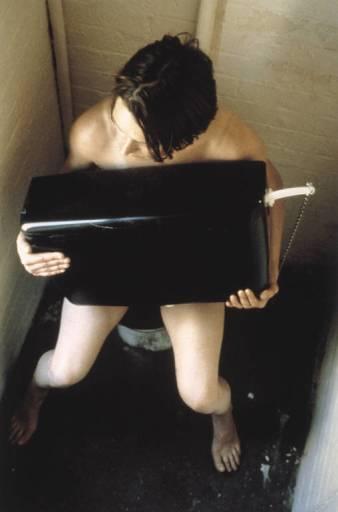 Human Toilet II 1996
from Self-Portraits 1990-1998 (P78443-P78454; complete)
Inkjet print on paper
image: 737 x 489 mm
on paper, print
Purchased 2001 Tate Gallery
Release da Exposição “God is Dad”
Sarah Lucas, February 5—March 14, 2005
Gladstone Gallery is pleased to announce an exhibition of new work by Sarah Lucas. Initially heralded amongst her peers in the 1990s as a key member of the movement of Young British Artists, she has developed a signature style addressing the raunchy underbelly of pop culture and gender dynamics. Using self-portraiture, found-object constructions, and collage, Lucas confronts the alternately grotesque and absurd euphemistic associations with the body and sex, humorously breaking down the camouflage of Puritanism, political correctness, and sexism from which these negative abstractions arise.
Mixing commonplace household items such as wire hangers, stockings, and buckets with the detritus of tabloid clippings and advertising fliers, Lucas creates makeshift sculpture that slyly deconstructs assumed linguistic and gender codes. While seemingly simple, if not crude, her arrangements of objects, be they fruit or fluorescent tubing, posses a sophistication in their method of recalling complex socio-sexual relationships while referencing art historical antecedents such as Surrealism, Arte Povera, and Minimalism. The bawdy tone consistent in both her sculpture and self-portraiture fights fire with fire, confronting the misogynistic tendencies of contemporary British culture. A careful balance of the blatant and the subtle, she ties lewd clichés and desultory slang to sculpture while exposing its linguistic meaninglessness. The pairing of humor, as evidenced in the titles of her work, and the rough-hewn aesthetic she favors not only matches in vulgarity the sexism she attacks, but serves to deflate the offense by holding a mirror to it.
For this exhibition, Lucas incorporates a pared-down vocabulary to create taut and thoughtful works meditating on themes that have always held her interest: the double bind faced by contemporary women, the messy intricacies of sex and love, and the rickety concepts of domesticity and religion. Using Victorian bed frames, stockings, and bald light bulbs, she evokes the untidiness of the body, the futility in the conventions used to frame and control it, and in the end, the pessimism that notions of monogamy and life-long commitment stir up in the contemporary mind. Because of the light touch Lucas applies through humor, the responses these evoke are never so cut and dried: By towing the lines of vulgarity and thoughtfulness her sculptures provoke questions about the mediation of base humanity in society, as much as they try to resolve the inherently tangled subjects she queries.

The Pleasure Principle, 2000, installed in Freud's dining room.
Born in London in 1962, Sarah Lucas studied at Goldsmiths College and became an integral part of the YBA movement. Since her inclusion in the seminal exhibition Freeze, in London in 1988, she has been exhibited internationally including solo exhibitions at the Museum of Modern Art, New York in 1993; the Museum Boymans-van Beuningen in Rotterdam; and Portikus, Frankfurt during 1996. She has also been included in numerous group shows and surveys such as Brilliant at the Walker Art Center, Minneapolis in 1995 and Sensation: Young British Artists in the Saatchi Collection at the Royal Academy of Art in London and the Brooklyn Museum of Art in 1997. In 2004, along with friends and fellow artists Angus Fairhurst and Damien Hirst, Lucas collaborated for the exhibition “Ina-Gadda-Da-Vida” at Tate Britain. “God is Dad” will be accompanied by a fully illustrated catalogue with an essay by art historian Linda Nochlin.
Gladstone Gallery
Monday, June 27, 2005
Peter Doig
1959 nascido em Edinburgh, vive e trabalha em Londres, Inglaterra
"I'm not trying to make paintings look like photos. I want to make paintings using photos as a reference, the way painters did when photography was first invented." —Peter Doig, 2002
 Daytime Astronomy, 1997
Peter Doig pinta paisagens pitorescas inspiradas em imagens fotográficas, filmes, livros e outros meios de comunicação social populares. Em "Night Fishing", 1993, Doig começou com uma imagem de um anúncio para umas férias de pesca no Canadá, a partir do qual criou um cenário de um lago ao anoitecer. "Daytime Astronomy", 1997-98, foi inspirado numa fotografia de Jackson Pollock tirada por Hans Namuth, na qual Pollock está deitado a olhar para cima. Doig não pinta cenas da natureza a partir da paisagem propriamente dita, e o seu recurso a reproduções é também indireto: ele trabalha a partir de fotocópias e esboços afastados por gerações dos seus originais através de repetidas evoluções das imagens. Doig criou múltiplas versões de cenas similares como pinturas e como desenhos e estudos íntimos. Inspirados por uma cena do filme de terror "Sexta-feira 13" pintou várias imagens de um lago com uma figura deitada sobre uma canoa.Uma série de trabalhos relacionados intitulados "Echo-Lake", nos quais a figura junta as mãos para gritar para o outro lado do lago, é inspirada no mesmo filme. Para além das fontes de cultura popular, Doig interessa-se pelo uso da cor intensa dos pintores do impressionismo e pós-impressionismo, assim como pelo efeito de máquina fotográfica do modo como os artistas visualizam o mundo natural há mais de um século. Apesar de o seu trabalho ter sido comparado ao de Gerhard Richter por causa da forte relação entre a pintura e a fotografia, Doig procura mais a tradição da pintura e a atitude de artistas como Friedrich, Constable e Monet, que interpretam a paisagem de forma abstrata.
Rochelle Steiner
do livro ART NOW
 Island Paintings, 2001
Mais imagens de Peter Doig
"I'm not trying to make paintings look like photos. I want to make paintings using photos as a reference, the way painters did when photography was first invented." —Peter Doig, 2002
 Daytime Astronomy, 1997
Peter Doig pinta paisagens pitorescas inspiradas em imagens fotográficas, filmes, livros e outros meios de comunicação social populares. Em "Night Fishing", 1993, Doig começou com uma imagem de um anúncio para umas férias de pesca no Canadá, a partir do qual criou um cenário de um lago ao anoitecer. "Daytime Astronomy", 1997-98, foi inspirado numa fotografia de Jackson Pollock tirada por Hans Namuth, na qual Pollock está deitado a olhar para cima. Doig não pinta cenas da natureza a partir da paisagem propriamente dita, e o seu recurso a reproduções é também indireto: ele trabalha a partir de fotocópias e esboços afastados por gerações dos seus originais através de repetidas evoluções das imagens. Doig criou múltiplas versões de cenas similares como pinturas e como desenhos e estudos íntimos. Inspirados por uma cena do filme de terror "Sexta-feira 13" pintou várias imagens de um lago com uma figura deitada sobre uma canoa.Uma série de trabalhos relacionados intitulados "Echo-Lake", nos quais a figura junta as mãos para gritar para o outro lado do lago, é inspirada no mesmo filme. Para além das fontes de cultura popular, Doig interessa-se pelo uso da cor intensa dos pintores do impressionismo e pós-impressionismo, assim como pelo efeito de máquina fotográfica do modo como os artistas visualizam o mundo natural há mais de um século. Apesar de o seu trabalho ter sido comparado ao de Gerhard Richter por causa da forte relação entre a pintura e a fotografia, Doig procura mais a tradição da pintura e a atitude de artistas como Friedrich, Constable e Monet, que interpretam a paisagem de forma abstrata.
Rochelle Steiner
do livro ART NOW
 Island Paintings, 2001
Mais imagens de Peter Doig
Friday, June 24, 2005
 Sonhei, confuso, e o sono foi disperso,
Mas, quando dispertei da confusão,
Vi que esta vida aqui e este universo
Não são mais claros do que os sonhos são
Obscura luz paira onde estou converso
A esta realidade da ilusão
Se fecho os olhos, sou de novo imerso
Naquelas sombras que há na escuridão.
Escuro, escuro, tudo, em sonho ou vida,
É a mesma mistura de entre-seres
Ou na noite, ou ao dia transferida.
Nada é real, nada em seus vãos moveres
Pertence a uma forma definida,
Rastro visto de coisa só ouvida.
Fernando Pessoa, 28-9-1933.
Pinturas da série "Meninas", finais de 2002

Das velhas impressões da infância a idéia grata
Perdura-nos fiel, volvam embora os anos;
Em vão do nosso Abril as flores sofrem danos,
A imagem delas fica indelével, exacta.
Subscribe to:
Posts (Atom)